
How Bench Warrants Work in Dooly County
A bench warrant generally begins with an existing court matter, not a fresh finding that a new crime occurred. A judge may use it after a failure to appear or other noncompliance, but Dooly County does not publish a local definition that assigns every missed obligation the same result. The safest approach is to ask the issuing court what event triggered the process and what the docket currently shows.
“Bench warrant” and “failure to appear,” or FTA, are the clearest Georgia-facing terms here. “Capias” can occur in court or probation material, yet no separate Dooly capias list or definition was located. A status entry should therefore be read in the context of its court, case, date, and current disposition.
Dooly Has No Public Bench-Warrant List
The Dooly Sheriff’s Warrants & Civil page describes the division but does not provide a name-search box, downloadable roster, status rows, or an update date. That absence is important: failing to find a person on the public website does not establish that no warrant exists.
For a check about one’s own status, call the Sheriff’s Office at (229) 645-0920 with the full legal name, date of birth, and county ready. Georgia’s official warrant guidance warns that appearing at a law-enforcement office while a warrant is active can lead to custody, so call first and ask what identification, appointment, surrender, or court-contact instructions apply.
Bench Warrant Issuance in Dooly County
The judge assigned to the underlying case controls whether court noncompliance results in a bench warrant. Once issued, the process authorizes law enforcement action, while the related case remains with its court. The Sheriff serves or holds warrant information; it is not the judge and cannot independently rewrite a court order.
Georgia Uniform Magistrate Court rules add context after an arrest. Rule 25.1 lists first-appearance duties, while Rule 25.2 covers commitment proceedings and sending the warrant, bond, and related papers to the proper clerk. Those statewide rules do not announce a Dooly grace period or promise advance notice before issuance.
The Missed-Date Call: Court First
When the concern follows a missed citation or hearing, begin with the court shown on the paperwork. Ask whether an FTA was entered, whether a bench warrant was issued, whether a new appearance is required, and who has authority to recall it. A payment vendor can process an eligible amount but cannot establish judicial recall merely by issuing a receipt.
Have ready: full legal name, date of birth, citation or case number, scheduled date, issuing agency, and the city or county named on the papers.
Vienna’s Government Window page is limited to traffic payments. Unadilla publishes a first-Tuesday City Court schedule. Neither is a public bench-warrant roster, so a missed-date question still belongs with court staff and, for current county-held status, the Dooly Sheriff.
How Bench and Arrest Warrants Differ
Both instruments can authorize an arrest, but their starting points differ. The companion Dooly arrest warrant lookup explains probable-cause process in greater detail.
| Feature | Bench warrant | Arrest warrant |
|---|---|---|
| Typical starting point | Existing case and missed court obligation | Alleged offense and probable-cause process |
| Authority | Judge in the pending court matter | Judge or magistrate acting on a warrant application |
| Record trail | Docket, appearance, FTA, and recall status | Application, issuance, service, return, and criminal case |
| Next question | What must the issuing court receive or schedule? | What surrender, first-appearance, and bond instructions apply? |
Dooly Court Roles at a Glance
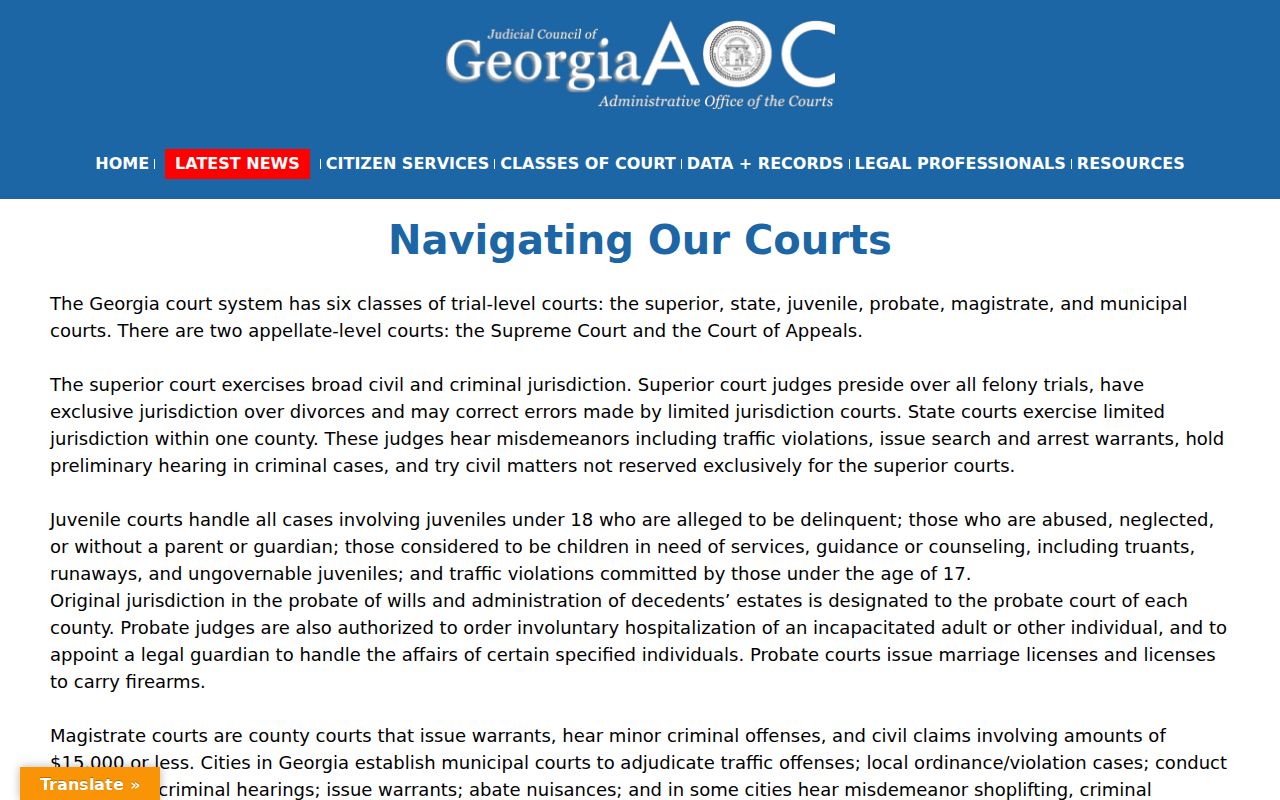
The Georgia Courts jurisdiction guide explains why the court name matters. Superior Court has general felony jurisdiction. Magistrate Court handles county warrant applications, minor crimes, and first appearances. Municipal Courts handle city traffic and ordinance matters and may issue warrants. Juvenile matters have separate access limits, while Probate Court appears in Dooly’s citation-payment route rather than as a universal criminal-warrant clerk.
The official guide’s court map can help a reader avoid sending a recall question to the wrong office.
Clearing a Bench Warrant in Dooly County
No Dooly walk-in recall window, standard recall fee, or universal online form was found. The route must be confirmed for the individual court and case.
- Confirm current status and identify the exact issuing court before traveling.
- Ask whether a judge must schedule an appearance, whether surrender is required, and whether counsel may file a motion.
- Confirm bond eligibility, acceptable form, hours, identification, and the next court date; no current local bond schedule was located.
- After completing the ordered step, request court confirmation that the warrant was recalled or otherwise changed.
Caution: Do not assume a payment receipt clears a bench warrant. Only the issuing court can confirm recall, and active process may lead to arrest.
Dooly Warrant Status Fields to Confirm
A useful status check is more specific than a yes-or-no answer. Ask for the warrant or case number, issuing court, issue date, alleged or underlying charge, bond notation if publicly available, and status language such as active, served, recalled, cancelled, or returned. Also ask when the status was last confirmed and which office controls the next step.
- Issued
- The judge authorized the warrant.
- Served
- Law enforcement executed the process; it does not mean the underlying case ended.
- Recalled
- The court withdrew the warrant. Obtain current confirmation rather than inferring recall from payment.
- Restricted
- Some information may be withheld because it is sealed, juvenile, investigative, or otherwise legally limited.
Dooly County Courts That Issue Bench Warrants
Superior Court records are maintained through the Clerk of Superior Court for matters within that court. Magistrate Court is the county-level route for warrant applications and first appearances. A city traffic or ordinance case may instead belong to Vienna, Unadilla, or another municipal court. Use the citation, docket notice, or case number to identify the court before requesting action.
For general current-status confirmation, the Dooly Sheriff is the countywide contact. For recall, rescheduling, or an order changing status, return to the issuing court. The broader Dooly warrant check route helps separate Sheriff, clerk, and city channels.
Open Records for Dooly Procedures
If phone confirmation cannot answer a record question, send a narrow written request to the likely custodian under the Georgia Open Records Act, O.C.G.A. §§50-18-70 through 50-18-76. The Georgia Attorney General’s request guidance recommends identifying the custodian and describing the records sought. Ask for a particular warrant-status record or current blank procedure, not legal advice.
The Sheriff may hold execution and active-status records; the Clerk of Superior Court maintains that court’s filings; Magistrate Court holds its records; and a municipal clerk handles city matters. Access can be limited for sealed, juvenile, sensitive personal, or active-investigation material. Dooly-specific search fees and response promises were not published in the reviewed sources, so confirm current terms with the custodian.
A focused request should state the person or case identifier, the issuing court if known, the particular status or document sought, and the preferred delivery method. Avoid asking one office to search every possible court without a case reference. If the custodian redirects the request, record the new office and narrow it again. A released copy may contain redactions, and a docket entry can require a follow-up status call when service or recall happened after the document date.
Keep the response with every new hearing notice, bond paper, or recall order. Use the same identifiers in a later status call so staff can distinguish the warrant from the underlying case. A historical warrant document may remain in the file after service or recall, so its existence alone does not prove active status. Ask which entry reflects the latest judicial action and when the Sheriff should receive that update.
No official Dooly bench-warrant caseload, failure-to-appear percentage, average service time, or recall-time measure was located. Population totals, arrest announcements, and court schedules cannot fill that gap. An individual status check should stay focused on the current court entry and Sheriff confirmation. If the answer changes, record the date, office, and staff-provided next step without publishing sensitive personal details.